5 Best Air Purifier Test Chambers for Global Buyers

Time:2026-10-11 Author:Mason
0%

Choosing the right Air Purifier Test Chamber can influence product credibility, export readiness, and customer trust. Global buyers need more than attractive specifications. They need repeatable evidence from controlled, well-documented testing.

A reliable chamber should control room volume, temperature, humidity, airflow, and particle concentration. It should also record results clearly, using calibrated instruments and transparent test procedures. Small details matter. A sealed door, stable aerosol generation, and clean sampling lines can change the final result.

Dr. Richard Corsi, a respected indoor-air-quality researcher, has said, “There is no substitute for good ventilation.” His point remains important. An air purifier may perform well inside a chamber, yet real rooms contain open doors, furniture, people, and uneven airflow. Laboratory results should guide decisions, not replace practical judgment.

This guide examines five Air Purifier Test Chamber options for international buyers. It considers chamber design, measurement accuracy, operating range, maintenance demands, and documentation quality. The comparison also looks at usability for manufacturers, laboratories, and certification teams.

No chamber is perfect. Some systems offer advanced automation but require expensive maintenance. Others are simpler, though their data management may feel limited. That trade-off deserves honest attention.

Testing experience often reveals uncomfortable gaps. A chamber can appear impressive while producing inconsistent readings. Therefore, buyers should inspect calibration records, validation reports, sensor placement, and after-sales support before purchasing.

The strongest choice is not always the most expensive one. It is the chamber that produces dependable results under clearly defined conditions.
5 Best Air Purifier Test Chambers for Global Buyers

Air Purifier Test Chambers: Purpose, Structure, and Testing Principles

5 Best Air Purifier Test Chambers for Global Buyers

Air purifier test chambers create controlled conditions for measuring real cleaning performance. This matters because the World Health Organization’s 2022 Air Quality Database found that 99% of people breathe air exceeding its guideline limits. A chamber reduces outdoor interference, making results more comparable across countries and laboratories.

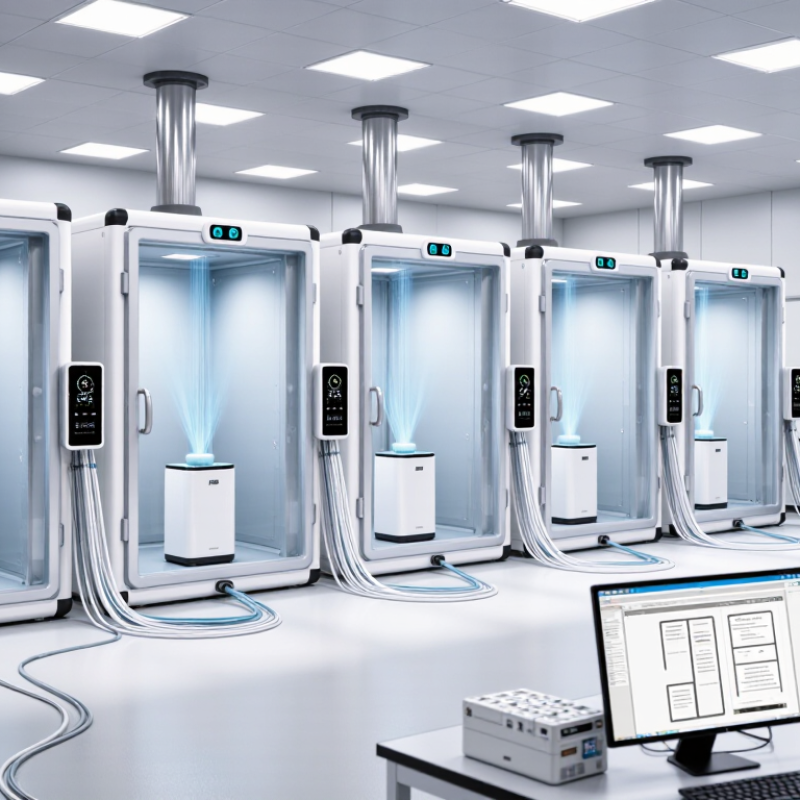
A typical chamber uses sealed walls, an aerosol generator, mixing fans, sampling ports, and calibrated particle instruments. Temperature, humidity, pressure, and background concentration require continuous monitoring. Technicians first measure the natural particle decay. They then introduce a controlled challenge aerosol, allow concentration to stabilize, and operate the purifier under defined settings. Particle readings are collected before and after treatment. The result may support clean air delivery rate calculations, following methods described in AHAM AC-1.

Details matter.

The U.S. Environmental Protection Agency’s Residential Air Cleaners technical guidance notes that indoor pollutant concentrations can be two to five times higher than outdoor levels, although conditions vary widely. Therefore, a chamber should test multiple particle sizes and humidity conditions, not only one convenient setting. A reliable design also prevents leaks and avoids dead zones near corners. In practice, perfect mixing is difficult. Some chambers still show uneven concentration, especially with bulky equipment. That weakness should be reported, not hidden. Calibration records, repeat tests, and uncertainty analysis strengthen the evidence and help global buyers judge whether published results are genuinely transferable.

Key Performance Specifications for Comparing Test Chambers

5 Best Air Purifier Test Chambers for Global Buyers

Key Performance Specifications for Comparing Test Chambers

A reliable test chamber begins with controlled volume and verified airtightness. Chamber size should match the purifier’s rated airflow without creating unusual recirculation. Uniform mixing matters. A well-designed system prevents particle concentrations from collecting near corners, sensors, or the test unit.

During chamber evaluations, I check temperature and relative humidity stability across the full test period. Small changes can affect particle behavior and purifier performance. A suitable aerosol generator should produce repeatable concentrations, while calibrated particle counters must provide traceable measurements. Data logging should record airflow, pressure, concentration, temperature, and humidity at practical intervals.

Look for low background particle levels before every test. Verify leakage through decay testing, not only manufacturer statements. Testing methods should align with the buyer’s target market and applicable international standards. Repeatability is equally important; identical tests should produce closely matched results. It is easy to overvalue a polished interface. That can be misleading. Service access, sensor replacement, calibration support, and software export often determine long-term reliability. My own preference is a chamber with transparent uncertainty reports, even when the numbers reveal weaknesses. Perfect data rarely exists. Honest limitations are more useful than impressive specifications.

Five Leading Air Purifier Test Chamber Options for Global Buyers

Global buyers need air purifier test chambers that produce comparable, repeatable results across different markets. The five leading options include sealed-room chambers, modular chambers, walk-in chambers, ducted-airflow chambers, and compact bench-scale chambers. Each design serves a different testing purpose. A sealed-room chamber supports room-size performance tests, while a compact chamber suits early product screening. Modular systems offer easier expansion when testing requirements change.

A reliable sealed-room chamber should control temperature, humidity, and background particle levels. Smooth interior panels reduce dust retention around corners. Modular chambers can include adjustable air inlets, access ports, and removable sensor mounts. Walk-in chambers provide space for larger purifiers, furniture simulations, and longer operating cycles. Ducted-airflow chambers help specialists study airflow resistance and filtration behavior under controlled volumes. Compact chambers save laboratory space, but their smaller dimensions may not represent real room conditions accurately.

During equipment selection, buyers should inspect calibration records, leakage testing, airflow uniformity, and data logging functions. A chamber with clear maintenance access usually reduces downtime. International teams also need stable power compatibility and documented operating procedures. No chamber is perfect. A highly controlled environment can still produce misleading results if sensors sit too close to an outlet. I have found that small setup errors often matter more than impressive specifications. Independent verification, repeat tests, and trained operators remain essential for dependable comparisons.

5 Best Air Purifier Test Chambers for Global Buyers - Five Leading Air Purifier Test Chamber Options for Global Buyers
Test Chamber Option Typical Internal Volume Recommended Test Device Size Typical Air Exchange or Mixing Control Particle Test Capability Environmental Control Common Reference Methods Best-Fit Applications
1. Compact Single-Unit Performance Chamber Approximately 1–3 m³ Portable and desktop air purifiers; units with a footprint up to about 0.6 m² Low-speed mixing fan with adjustable circulation; controlled air exchange typically around 0.1–2 air changes per hour Fine-particle decay and removal tests using generated aerosols or calibrated particle sources; commonly measured across approximately 0.3–10 µm Typical control range: 20–30°C and 30–70% relative humidity ISO 16000-9 ISO 16000-36 ASTM D6670 Product screening, engineering comparison, development testing, and laboratories with limited floor space
2. Standard Residential-Room Chamber Approximately 10–30 m³ Most residential portable air purifiers, including floor-standing models and larger room units Mechanical mixing and adjustable make-up air; commonly configured for approximately 0.2–1.0 air changes per hour during steady-state testing Particle concentration decay, clean-air delivery evaluation, background concentration control, and filter performance verification Typical control range: 20–26°C and 40–60% relative humidity; uniformity should be verified before testing ISO 16000-9 AHAM AC-1 GB/T 18801 Residential product validation, comparative CADR testing, consumer-appliance development, and routine quality control
3. Large-Volume CADR and Room-Scale Chamber Approximately 30–100 m³ High-capacity portable purifiers, multiple devices, and units designed for large rooms Distributed mixing system with controlled supply and exhaust; test conditions may cover approximately 0.1–2.0 air changes per hour High-volume aerosol dispersion, clean-air delivery rate measurement, concentration decay, and spatial uniformity mapping Typical control range: 18–30°C and 30–70% relative humidity; stable conditions are required for repeatable results AHAM AC-1 GB/T 18801 ISO 16000-9 Large-room purifier evaluation, export-market documentation, higher-airflow devices, and multi-unit comparison studies
4. VOC and Gas-Phase Air Purifier Chamber Approximately 1–30 m³, depending on the test configuration Portable purifiers with activated-carbon, photocatalytic, chemisorption, or other gas-phase filtration media Low-background construction with controlled injection, mixing, sampling, and purge functions; air exchange is commonly adjustable from about 0.1–2 air changes per hour Volatile organic compounds and selected gas challenges; analysis may use sorbent tubes, gas chromatography, photoionization detection, or equivalent validated instruments Typical control range: 20–30°C and 30–70% relative humidity; low-emission materials are important for chamber construction ISO 16000-9 ASTM D6670 ISO 16000-6 Odor-control research, VOC removal assessment, carbon-filter development, and gas-phase media comparison
5. Aerosol Challenge and Microbiological Test Chamber Approximately 1–20 m³ Portable purifiers, HVAC-compatible units, and devices requiring controlled aerosol or bioaerosol exposure Sealed or semi-sealed operation with controlled aerosol injection, mixing, sampling, and decontamination cycles; airflow must be validated for uniformity Non-biological aerosol testing and, where legally permitted, controlled microbiological or surrogate challenges using validated containment and sampling procedures Typical control range: 20–30°C and 40–70% relative humidity; pressure control and decontamination provisions may be required ISO 14698 ISO 16000-36 ASTM E283 HEPA and high-efficiency filtration research, aerosol penetration studies, contamination-control investigations, and specialized laboratory testing
Note: The specifications shown are representative test-chamber ranges rather than universal requirements. Chamber volume, air-exchange rate, aerosol type, sensor accuracy, recovery time, and applicable standards should be confirmed according to the target market, purifier capacity, and selected test method.

Testing Standards, Calibration, and Laboratory Compatibility

Global buyers should judge an air purifier test chamber by measurement discipline, not polished hardware. WHO’s 2022 air-quality database found that 99% of people live above its guideline limits for fine particles. That pressure makes repeatable chamber results commercially important.

Standards come first.

ISO 16000-36 supports indoor-air sampling principles, while ISO 29463 addresses high-efficiency filter performance. ISO 10121-2 is relevant for gas-phase air-cleaning devices. A suitable chamber should document airflow, mixing time, temperature, humidity, and background concentration. Test reports should state the loading aerosol, particle-size distribution, face velocity, and instrument uncertainty. Without those details, two impressive results may describe different experiments.

Calibration separates a laboratory-grade chamber from a sealed room with sensors.

Particle counters need traceable calibration, zero checks, leak testing, and scheduled flow verification. Gas analyzers also require certified reference mixtures and recovery checks. ISO/IEC 17025 accreditation strengthens confidence by linking methods, competence, and records. Still, accreditation is not magic. Weak chamber mixing can remain hidden. Ask for mapping data from multiple sampling points, not one convenient outlet.

Compatibility deserves equal attention. The chamber should accept the laboratory’s power supply, data system, duct geometry, and safety controls. WHO’s Global Air Quality Guidelines set annual PM2.5 at 5 μg/m³, so background control cannot be an afterthought. Small leaks matter. Review raw data, calibration certificates, uncertainty budgets, and failed-test records before comparing five chambers.

How to Select the Right Chamber for Budget, Scale, and Market Needs

For global buyers, the five most practical air purifier test chambers are small sealed rooms, modular room chambers, climatic chambers, duct-test systems, and full-scale living-space chambers. Each serves a different decision. Small rooms suit early product screening and tight budgets. Modular chambers support repeated tests as product capacity grows. Climatic chambers add temperature and humidity control. Duct systems measure filtration performance in controlled airflow. Full-scale chambers reveal how devices behave around furniture, doors, and occupied-space patterns.

Budget should follow evidence needs, not appearance. A basic sealed chamber may be enough for CADR comparison under stable conditions. However, international projects often need controlled humidity, particle concentration, airflow, and data logging. The ANSI/AHAM AC-1 method remains widely used for portable air cleaner performance testing. Its room-based approach makes volume, mixing, and measurement placement important. A cheaper chamber can become an expensive mistake. I would question any quotation that omits calibration, leakage testing, or replacement-filter access.

Market needs also shape the right chamber. The World Health Organization reported in 2022 that 99% of people lived in places exceeding its air-quality guideline for PM2.5. This increases demand for credible particulate testing, but markets differ in required methods. Choose sensors with traceable calibration and document every test condition. Leave space for future standards. That part is easy to overlook. A chamber designed only for today’s product may limit tomorrow’s exports.

FAQS

What chamber size is suitable for an air purifier?

Choose a volume that matches the purifier’s rated airflow. The chamber should avoid unusual recirculation and stagnant corners. A larger room is not always better.

Why is airtightness important during testing?

Leakage can reduce particle concentration and distort purifier results. Use decay testing before regular measurements. Small leaks matter.

How can chamber mixing quality be verified?

Measure particle levels at several locations, including corners and near sensors. Results should remain reasonably uniform across the room. One sampling point is insufficient.

Which environmental conditions should the chamber control?

Temperature and relative humidity should remain stable throughout each test. Both conditions can change particle behavior and cleaning performance. Small changes may still matter.

What instruments does a reliable chamber need?

It should include calibrated particle counters, airflow sensors, and environmental sensors. Gas testing requires analyzers with certified reference mixtures. Traceable calibration builds confidence.

What information should a test report include?

Reports should state airflow, mixing time, background concentration, and test duration. They should also identify aerosol type, particle sizes, and measurement uncertainty. Missing details weaken comparisons.

How should buyers compare chamber types?

Small sealed rooms suit early screening and limited budgets. Modular rooms support growing product ranges and repeated testing. Climatic rooms control temperature and humidity. Duct systems focus on controlled airflow performance.

What long-term features are easy to overlook?

Check sensor replacement, calibration support, service access, and data export. Leave space for future methods and changing market requirements. A polished interface can mislead. Perfect data is rare.

Conclusion

An Air Purifier Test Chamber is a controlled laboratory environment used to evaluate how effectively an air purifier removes particles, gases, odors, and other airborne contaminants. This article explains the chamber’s main structure, including the sealed enclosure, air-mixing system, sampling ports, sensors, filtration controls, and monitoring equipment. It also introduces key specifications for comparison, such as chamber volume, concentration uniformity, air exchange rate, measurement accuracy, environmental control, safety features, and data management capabilities.

The article reviews five practical test chamber options for global buyers, focusing on different needs in capacity, automation, flexibility, and investment level. It also discusses relevant testing standards, calibration procedures, laboratory compatibility, installation requirements, and routine maintenance. Finally, readers will learn how to select the most suitable chamber according to budget, testing scale, product types, target markets, facility conditions, and long-term research or certification goals.


Mason

Mason

Mason is a seasoned marketing professional with a deep expertise in the company's offerings and a passion for driving brand awareness. With a strong background in digital marketing strategies, he has an innate ability to connect with diverse audiences and effectively communicate product benefits.......